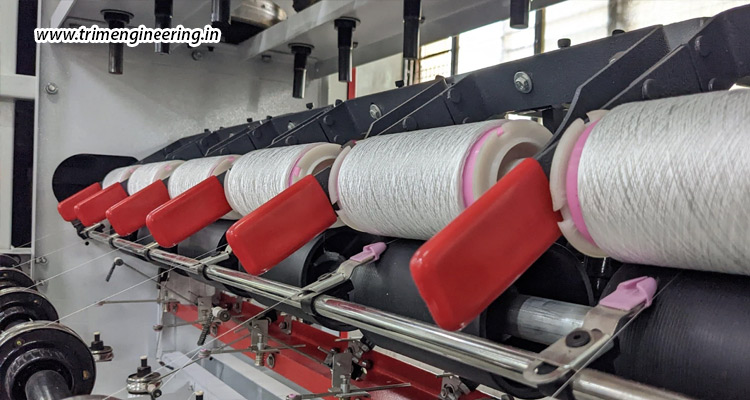
In textile manufacturing, consistent yarn tension and uniform winding are essential for production efficiency and product quality. While machinery and yarn characteristics receive considerable attention, industrial bobbins also influence yarn behaviour during winding, twisting, and unwinding. Their geometry affects yarn support, package formation, and smooth delivery during subsequent processes. Different applications, including twisting, doubling, rope yarn production, cable twisting, spinning, and braiding, require specific bobbin designs. Understanding the relationship between bobbin shape, yarn tension, and winding quality helps manufacturers select suitable dimensions, flange configurations, barrel designs, materials, and constructions for reliable performance across different textile machinery and production requirements.
Why bobbin geometry matters in yarn processing
A bobbin provides the surface around which yarn is wound and the structure from which it is subsequently released. During operation, yarn moves across the bobbin at a controlled rate while the bobbin rotates at considerable speed. Any irregularity in the bobbin’s geometry can influence yarn movement and affect tension consistency. Stable tension is important throughout winding and unwinding because excessive variation may contribute to uneven package formation, yarn breakage, irregular twisting, and inconsistencies in the finished product. A properly designed bobbin supports controlled yarn placement and stable package formation, helping maintain predictable yarn movement. Geometry becomes particularly important in demanding applications where heavy yarns, high-strength fibres, and continuous twisting place greater mechanical demands on the bobbin. Dimensional stability, secure yarn containment, and rotational balance are therefore essential considerations.
Understanding the main elements of bobbin geometry
Bobbin performance depends on several interconnected design features that determine how effectively it supports the yarn and operates within the textile machine.
- Barrel forms the primary winding surface. Its diameter affects yarn capacity and influences winding and unwinding characteristics.
- Bore must accurately match the machine spindle to ensure proper positioning and stable rotation.
- Flanges contain the yarn package and prevent yarn from extending beyond the intended winding area, supporting package stability.
- Overall dimensions including the length and diameter must suit the specific machine and application to maintain proper yarn delivery.
- Proper rotational balance helps minimize unwanted vibration and supports stable bobbin operation, particularly at higher machine speeds.
How bobbin diameter affects yarn tension
Bobbin diameter influences both package capacity and the rotational behaviour of the bobbin and yarn package. A suitably selected diameter can provide greater yarn capacity when combined with the appropriate bobbin length and winding configuration. However, diameter also affects the relationship between rotational speed and yarn delivery as the package builds during winding or reduces during unwinding. Changes in the effective package diameter can therefore influence yarn tension if the bobbin and machine parameters are not properly matched. Diameter selection should consequently consider more than the required yarn quantity. Machine speed, spindle specifications, yarn characteristics, package dimensions, and winding conditions all need to be evaluated together. Selecting an appropriate diameter helps maintain predictable yarn movement and supports consistent package formation, which can contribute to reliable winding performance across continuous textile operations.
The importance of bobbin length
Bobbin length contributes to package capacity and the quality of yarn distribution during winding. A longer barrel can provide additional package capacity when combined with a suitable diameter and winding configuration. However, the available machine space, yarn path, spindle arrangement, and required package dimensions must also be considered. If the bobbin length is not properly matched to the machine, yarn may not be distributed evenly across the available winding surface. This can result in an irregular package that may affect subsequent unwinding and yarn handling. Length is therefore an important part of overall bobbin design rather than an isolated dimension. For specialized textile machinery, the bobbin length should be selected according to the machine’s operating requirements, yarn characteristics, package specifications, and intended production process to support stable winding and efficient yarn delivery.
The influence of bobbin shape on yarn tension
Yarn tension depends on several interacting variables, with bobbin geometry representing one important part of the overall yarn-handling system. A properly matched bobbin can support stable yarn movement by maintaining the package securely and providing consistent support during operation. Flange geometry can help limit unwanted lateral yarn movement, while suitable barrel dimensions can contribute to orderly package formation. Accurate spindle fit and proper rotational balance can further support smooth movement during high-speed operation. However, bobbin shape should not be considered the sole cause of tension variations. Yarn properties, winding speed, machine settings, tension devices, yarn guides, and package construction also influence tension. Considering these factors together allows manufacturers to select bobbin designs that support predictable yarn movement, consistent package formation, and reliable winding performance throughout textile production processes.
How different bobbin designs influence yarn stability and machine performance
Different bobbin designs are developed to address specific yarn-handling, package-containment, weight, and machine-compatibility requirements across diverse textile manufacturing processes.
- Flange bobbins: Raised flanges contain yarn within the winding area, reducing lateral movement and supporting stable package formation during twisting, doubling, and continuous textile operations at varying speeds and tensions.
- Double flange bobbins: Flanges at both ends provide stronger yarn containment and help prevent lateral package movement. They are suitable for fishnet twine, tire cord, rope yarn, cable twisting, and doubling applications.
- Perforated bobbins: Openings through the bobbin body can reduce weight, enhance heat dissipation, and improve airflow around the yarn package. Proper perforation patterns must maintain adequate strength, balance, and structural stability during operation.
- Machine-specific bobbin designs: Different textile machines require bobbins with specific geometries, dimensions, and ring diameters. Suitable designs are available for TFO systems, draw twisting machines, rope machines, ring twisters, and braiding equipment.
Choosing the right bobbin design
Selecting the right bobbin should begin with the machine and application rather than with the bobbin shape alone. Manufacturers should consider the type of yarn being processed, machine configuration, operating speed, required package capacity, spindle dimensions, and production conditions. The selected design should provide adequate yarn containment, stable rotation, and consistent package formation throughout operation. Flange and double flange designs may be suitable where yarn containment is a priority, while perforated bobbins can be considered where reduced weight or airflow is beneficial. The objective is to select a bobbin design that supports stable yarn movement and tension while remaining compatible with the specific machinery and process requirements.
Material and geometry must work together
Shape alone does not determine bobbin performance. The material from which the bobbin is produced also affects how its geometry behaves during operation. Nylon and other plastic bobbins can provide lightweight solutions where reduced rotational mass is advantageous. Phenolic flange bobbins offer a different combination of rigidity and dimensional stability. Aluminium flange bobbins can provide a robust solution where strength and metal construction are required. The appropriate material should therefore be considered together with the bobbin’s dimensions and geometry. A particular shape may perform differently depending on whether it is manufactured from a lightweight polymer, phenolic material, or metal.
The shape of an industrial bobbin influences yarn containment, winding, release, and overall machine performance. Flange, double flange, and perforated designs serve different operational requirements, while barrel dimensions affect package capacity and winding characteristics. Bobbin construction and material selection also influence durability, rotational stability, and suitability for continuous textile operations. For precision-engineered solutions, an experienced BOBBIN manufacturer in India such as Trim Engineering can offer plastic, nylon, phenolic, aluminium, perforated, and flange bobbins for different textile applications. Ultimately, selecting the right bobbin requires considering geometry, material, machine compatibility, and yarn characteristics together. Proper alignment of these factors supports stable tension, consistent winding quality, reliable operation, and efficient textile production.