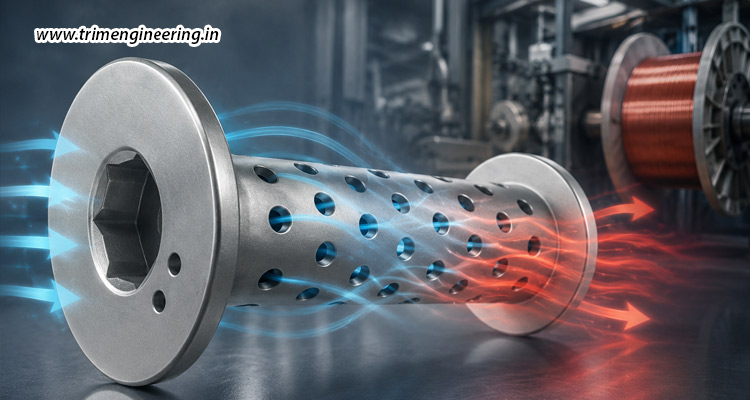
In modern industrial winding systems, efficiency comprises not just speed and precision, but also the management of heat produced during continuous operation. Metal bobbins utilized in wire, cable, textile, and filament winding systems frequently function under high rotational speeds and persistent mechanical loads. In these conditions, heat accumulation poses a significant challenge that can impact product quality, machine performance, and operational safety. Perforated metal bobbins have surfaced as a viable engineering solution to tackle this issue. By integrating strategically placed holes or openings within the bobbin structure, manufacturers can enhance airflow, minimize thermal buildup, and improve overall winding efficiency. This blog delves into how perforations facilitate heat dissipation, the importance of thermal control in industrial winding, and the influence of design considerations on performance.
Understanding heat generation in metal bobbins
What causes heat generation in bobbin systems? During high-speed winding processes, various factors contribute to heat generation, such as:
- Friction between the wire and the bobbin surface
- Rapid rotation at elevated RPMs
- Stress induced by tension in the winding material
- Friction in bearings and shafts within rotating assemblies
- Continuous operation with minimal cooling breaks
Due to their conductive properties, metal bobbins tend to absorb and retain this heat. Although metals are proficient at transferring heat, without adequate dissipation pathways, the heat remains concentrated within the structure and the surrounding wound material. This heat can result in:
- Softening or deformation of the wound material
- Diminished dimensional accuracy in winding
- Increased wear on mechanical components
- Thermal expansion leading to tension inconsistencies
- Reduced lifespan of both the bobbin and machinery
The importance of heat control in high-speed winding operations
Heat management is very crucial as it can have a significant impact on product quality and operational reliability.
- Preserving material integrity
Many winding materials like copper wire, optical fibres, and textile filaments are highly sensitive to temperature variations. Excessive heat can lead to damage to insulation, micro-deformation in fibres, and changes in yarn elasticity. Controlled thermal conditions prevent material fatigue and preserve key mechanical and electrical properties during winding, ensuring consistent performance and higher reliability in industrial applications.
- Guaranteeing consistent tension control
Fluctuations in temperature can influence expansion and contraction of materials. This results in inconsistent winding tension, loose or tight coils, and irregular layering. Stable thermal conditions facilitate smooth winding. Thermal stability maintains dimensional consistency, enabling precise tension control and reducing deformation, ensuring uniform coil formation and better product quality in high-speed production systems.
- Minimizing wear and tear of machine components
Excessive heat accelerates wear of shafts, bearings, and supports. Controlled heat reduces lubrication failure and thermal stress, improving machine smoothness, extending component life, and lowering maintenance needs in continuous industrial operation. This also enhances operational reliability, minimizes unexpected breakdowns, and supports long-term cost-effective production efficiency in demanding environments.
- Enhancing production efficiency
When machines operate within ideal temperature ranges, production speeds remain stable with fewer interruptions and lower rejection rates. Stable temperatures prevent overheating, improve cycle efficiency, reduce scrap, and ensure consistent manufacturing output. This also supports better process control, enhances product quality consistency, and increases overall plant productivity in continuous operations.
All in all, thermal efficiency improves productivity and ensures reliable industrial performance.
The principle of heat dissipation through perforation
In metal bobbins, perforation involves the deliberate creation of holes, slots, or patterned openings within the bobbin shell or flange. These openings are not arbitrary; they are meticulously designed to enhance airflow and thermal exchange. The primary mechanism in which perforations facilitate heat dissipation are as follows.
- Improved air circulation
When the bobbin spins at high speeds, air is naturally drawn across its surface. Perforations enable air to flow through the structure instead of merely circulating around it. This results in internal airflow channels, a continuous exchange of hot and cool air, and a decrease in stagnant heat pockets. This airflow functions as a passive cooling mechanism, requiring no external energy.
- Greater surface area exposure
Perforations significantly increase the surface area of the metal structure that is exposed. This increased exposure allows for quicker heat transfer to the surrounding air, enhanced convective cooling efficiency, and minimized localized overheating areas. Even minor adjustments in hole size and arrangement can significantly enhance thermal performance.
- Decreased thermal mass
By creating perforations, material is removed, which lowers the overall mass of the bobbin. A reduced thermal mass results in quicker heat response, less heat retention during ongoing operations, and faster return to optimal operating temperatures. This is especially advantageous in continuous production settings where downtime is limited.
- Enhanced convective cooling
Convection is one of the most efficient natural cooling techniques in rotating machinery. Perforations encourage turbulent airflow, which improves convective heat transfer. Rather than air flowing smoothly over a solid surface, perforated designs generate micro-turbulence, which disrupts thermal boundary layers, boosts heat exchange efficiency, and prevents heat accumulation in specific areas.
Design factors that affect heat dissipation efficiency
Not all perforated bobbins exhibit the same performance. The efficiency of heat dissipation is influenced by various design factors.
- Geometry of perforation patterns
The configuration of holes significantly impacts airflow dynamics. Common configurations include circular arrays for even cooling, radial patterns for uniform stress distribution, and staggered designs to promote turbulence. Each configuration alters airflow in unique ways, affecting cooling efficiency.
- Size and distribution of holes
Larger holes enhance airflow but can compromise structural integrity, while smaller holes preserve strength while offering moderate ventilation. Evenly spaced holes guarantee uniform cooling across the bobbin’s surface. A well-balanced design is crucial for achieving optimal performance.
- Material selection
The choice of metal also affects heat dissipation. For instance, aluminium is lightweight with excellent thermal conductivity, steel is high on strength with moderate thermal efficiency, while alloy combinations provide a balance of strength and heat transfer capabilities. The selection of materials plays a key role in how effectively heat is absorbed and dissipated.
- Wall thickness and structural reinforcement
Thinner walls can enhance cooling but may weaken the structure. Reinforcements around perforation areas help sustain durability while facilitating airflow. This balance ensures mechanical stability, prevents deformation under load, and maintains consistent performance during high-speed winding and continuous industrial operations requiring long-term reliability and structural integrity.
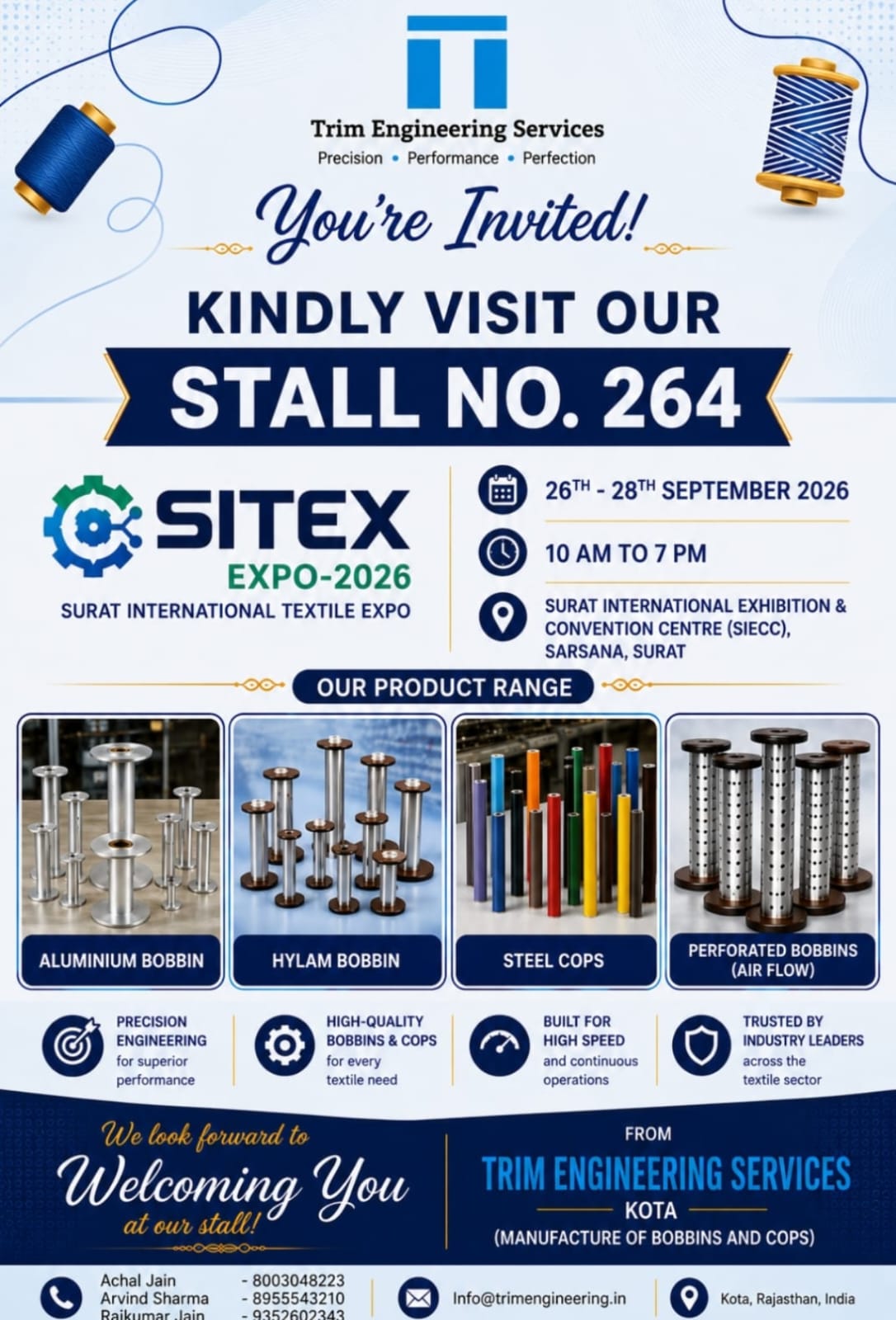
Trim Engineering stands out as a trusted PERFORATED METAL BOBBIN manufacturer in India,delivering precision-engineered solutions for industrial winding systems, ensuring reliable performance, enhanced durability, and efficient heat dissipation in high-speed applications across modern manufacturing environments and continuous operations reliably.
Perforations in metal bobbins serve not just as design features; they are practical engineering solutions that greatly improve heat dissipation during high-speed winding processes. By enhancing airflow, minimizing thermal mass, and facilitating convective cooling, perforated designs help maintain stable operating temperatures even in challenging industrial environments. Proper heat management is crucial for preserving material integrity, ensuring uniform tension, minimizing equipment wear, and boosting overall production efficiency. As industries strive for increased speeds and enhanced precision, perforated metal bobbins will continue to be an essential element in delivering dependable and efficient winding performance.