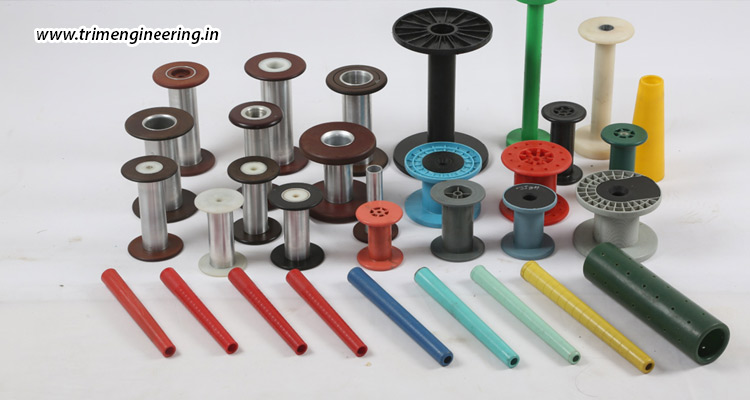
In textile manufacturing, achieving constant yarn tension and good winding quality are fundamental to guarantee defect-free production. While equipment and yarn characteristics are often paramount, the role of bobbin geometry is equally important. The shape and design of the bobbin directly affect how the yarn is wound, stored, and unwound, especially in high-speed operations such as twisting, doubling, braiding, and rope making. A bobbin is more than just a passive holder for yarn. These are specially designed components that affect voltage stability, layer formation, and overall process efficiency. Variations in geometry such as flange configuration, cylinder profile, and perforated design can significantly change the behaviour of the yarn. Understanding these geometric differences allows manufacturers to optimize machine performance, reduce yarn breaks, and improve product consistency.
Understand the relationship between bobbin shape and yarn tension
Yarn tension is one of the most sensitive parameters in textile processing. Even small variations can lead to defects such as uneven twist, insufficient winding density, or structural inconsistencies in the final product. The shape of the bobbin plays a central role in maintaining this tension. When the yarn is wound onto a bobbin, several layers are formed. When unwinding, the yarn should be released smoothly and evenly. If the shape of the bobbin prevents uniform stacking and unwinding, tension changes will occur. These changes are often caused by uneven yarn distribution, excessive lateral movement, or uneven contact between the yarn layer and the bobbin surface. Maintaining stable tension is essential in industrial applications such as rope yarn manufacturing, tire cord manufacturing, jute processing, and cable laying. Correct bobbin geometry ensures predictable yarn flow even under high speed and high load conditions.
Important aspects of the bobbin shape
To understand how shape affects performance, it’s important to look at the basic structural elements of a bobbin. These include:
- Barrel (core): The cylindrical surface around which the yarn is wound
- Flanges: Raised edges on one or both ends
- Length and diameter: The length and diameter of the bobbin
- Surface Preparation: Smooth or textured surfaces
- Perforations: Holes in the housing that reduce weight and improve airflow
Each of these factors influences the behaviour of the yarn throughout the production cycle, making geometry a key design element.
The impact of various bobbin shapes on yarn tension
- Straight cylindrical bobbin
Straight cylindrical bobbins have the same diameter throughout their length, with minimal structural differences. These provide a simple, uniform wrapping surface, but have limited control over the lateral movement of the yarn. As a result, it is ideal for controlled environments where additional guides and tension systems are present. In terms of tension, cylindrical bobbins can provide a uniform layup, but may not perform well in high-speed operations where yarn stability is essential. Without flanges, the risk of yarn slipping increases, especially when using heavy or high-tension yarns.
- Single flange bobbin
Single flange bobbins have a raised edge on one side to help hold line while winding. This design increases edge stability and reduces lateral movement of the yarn layers. From a tension control perspective, single-flange bobbins perform better than cylindrical designs because they maintain unilateral alignment. However, it is capable of some movement, making it better suited for medium-speed operations than demanding tasks.
- Double flange bobbin
Double flange bobbins are one of the most commonly used designs in industrial textile machinery. Featuring flanges on both ends to create a fully enclosed winding area and greatly improve line holding power. This shape has several advantages. First, it ensures even layering by preventing the yarn from moving sideways. Second, it maintains constant tension throughout the unwinding process even at high speeds. Third, it improves package stability. This is especially important for thick yarns used in ropes and cables. Because of these properties, double flange bobbins are often used in twisting machines, TFO systems, and rope yarn production lines where precision and stability are important.
- Perforated bobbin
Perforated bobbins have holes along the body and have both structural and functional benefits. The main purpose of perforations is to reduce weight, but they also improve airflow and heat dissipation. From a tension perspective, the reduced weight improves dynamic balance, especially at high speeds. This minimizes vibrations and ensures smooth yarn unwinding. Additionally, improved air circulation prevents heat build-up that can affect yarn properties and tension consistency. Perforated designs are particularly effective in high-speed applications where thermal control and weight savings are important.
- Profiled or modified bobbin shape
For special applications, the bobbin diameter and contour along the body may vary slightly. These streamlined designs are designed to optimize yarn distribution and reduce tension fluctuations. By controlling the formation of yarn layers, profiled bobbins help maintain uniform pressure throughout the package. This makes unwinding smoother and improves the winding density, which directly leads to improved product quality.
The importance of custom bobbin shapes
In many textile mills, standard bobbin geometries may not fully meet the needs of specialized equipment or unique yarn types. For this reason, special bobbins have been developed to solve specific problems. Customizations may include adjusting flange sizes, changing barrel profiles, adding holes, or advanced material selections. These custom designs ensure compatibility with machine specifications and optimize yarn handling. For manufacturers seeking high-performance solutions, working with an experienced BOBBIN manufacturer in India such as Trim Engineering provides access to a wide range of precision-engineered bobbins, including flange, perforated, aluminium, and fully customized designs.
The effect of dimensions on winding quality
In addition to the shape, the dimensions of the bobbin, especially the diameter and length, play an important role in determining the quality of the winding and its behaviours under tension. A larger diameter increases the productivity of the yarn, but also increases the centrifugal force when rotating. If not properly balanced, the voltage may change. On the other hand, smaller diameters provide better control but require more frequent bobbin replacement. Similarly, longer bobbins can store more yarn, but should be chosen carefully based on machine specifications. An incorrect length can cause the yarn to be misaligned, resulting in an irregular winding pattern. The key is to achieve a balance between performance and control, ensuring the bobbin delivers both efficient production and consistent line performance.
Bobbin shape is a decisive factor in determining yarn tension and winding quality in textile manufacturing. From cylindrical and flanged designs to perforated and contoured designs, each shape influences how the yarn is handled throughout the manufacturing process. Understanding the relationship between bobbin geometry, materials, and mechanical requirements allows manufacturers to make informed decisions that increase efficiency, reduce defects, and improve product quality. In a high-speed, high-precision environment, proper bobbin design is not only helpful, but essential to achieving consistent and reliable results.