In textile and industrial manufacturing, several components work together to ensure smooth material handling, consistent production, and high-quality output. Among these, spools and bobbins are two commonly used components that often create confusion due to their similar appearance and functions. While both spools and bobbins serve the purpose of winding and holding the thread and yarn in place, their design, applications, and performance requirements vary based on the industry and the manufacturing process. Understanding the difference between a spool and a bobbin is important for selecting the right component for specific applications, especially in industries like textile manufacturing, twisting, rope production, cable processing, and industrial yarn handling.
Understanding spools and bobbins
Both spools and bobbins are cylindrical winding components designed to store and manage continuous materials. They provide a controlled method for winding, unwinding, and transferring materials during various production processes. While their basic purpose is similar, their construction and usage vary based on a number of factors like the type of material being wound, the machine requirements, the tension control requirements, and the application. A suitable winding component helps maintain material quality, improve operational efficiency, and reduce production interruptions while ensuring smooth workflow and consistent output. It supports reliable performance across different industrial applications where precision and durability are essential for achieving higher productivity, minimizing material wastage, and improving the long-term efficiency of modern manufacturing systems.
What is a spool?
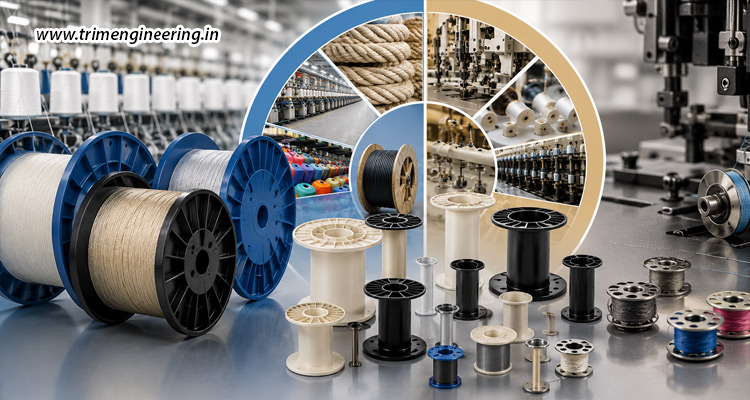
A spool is a cylindrical device used for winding and storing yarn, thread, wire, cable, and industrial fibre. It generally consists of a central barrel with flanges or edges that help keep the wound material securely positioned. Spools are commonly designed for applications where the material needs to be stored, transported, or transferred between different stages of production. In textile applications, spools play an important role in yarn winding, doubling operations, twisting processes, and industrial yarn handling. Their design allows controlled winding and smooth material release, ensuring consistency during manufacturing.
What is a bobbin?
A bobbin is also a cylindrical winding component, but is generally associated with textile machinery, where yarn or thread is temporarily stored during processing. Bobbins are commonly used in applications where the material is actively involved in a manufacturing process rather than to be simply stored or transported. They are widely used in spinning machines, twisting machines, sewing machines, and textile processing equipment. Their precise design allows controlled yarn movement, smooth rotation, and efficient material feeding, ensuring consistent performance and reducing operational issues during various textile manufacturing processes.
Key differences between spools and bobbins
Although spools and bobbins look similar and perform similar functions, they are significantly different from each other in many ways.
- Difference in their design and construction
While both spools and bobbins look similar, spools generally have larger dimensions and flanged structures. They have greater storage and higher load capacity. They are often engineered to handle continuous industrial operations where large quantities of material need to be wound. Bobbins are smaller and more application-specific. They have precise dimensions to be able to work on machines to ensure smooth rotation and proper yarn delivery. Spools are generally designed for larger-scale winding applications, while bobbins are made generally compatible with only particular textile machines and processes.
- Difference in their applications
Spools are commonly used when the primary requirement is efficient storage, handling, and transfer of materials. The typical applications include industrial yarn winding, rope manufacturing, wire handling, and cable processing. Bobbins are more commonly associated with textile production processes where yarn or thread is actively processed. The typical applications include spinning, twisting, weaving, sewing, and textile machinery operations. While both components support material management, the specific application determines which option is more suitable.
- Difference in their material handling capacities
Spools have greater material storage capacity compared to bobbins. They are designed to hold longer lengths of yarn, wire, or other continuous materials, making them suitable for industrial applications that require extended production cycles, continuous machine operation, and reduced material replacement frequency. Bobbins usually hold smaller quantities of material and are designed for controlled processing rather than long-term storage, where precision handling, accurate feeding, and compatibility with specific machinery are essential for efficient production.
Choosing between a spool and a bobbin
Selecting the correct component is essential, and depends on several operational factors.
- Application requirements
The first consideration is the intended application. A spool may be more suitable when large quantities of material need to be stored, long production cycles are required, and material transfer is a priority. Bobbins, on the other hand, may be preferable when precise yarn handling is required, and breaks between production can be accepted, most importantly, the component should be part of a specific textile process.
- Machine compatibility
The dimensions and design of the winding component must match the machinery. Some important factors to consider are the size, shape, weight requirements, rotation speed, and mounting arrangement. Using an unsuitable component can result in vibration, uneven winding, and reduced machine efficiency. Making the right choice is essential for ensuring smooth operations, maintaining product quality, and achieving consistent performance throughout the manufacturing process.
- Material and manufacturing quality
Regardless of whether a spool or bobbin is selected, manufacturing precision plays an important role. High-quality winding components should provide accurate dimensions, proper balancing, long service life, and smooth surface finish. Precision manufacturing ensures reliable performance even under demanding industrial conditions. Trim Engineering, a trusted bobbin and SPOOL manufacturer in India, delivers precision-engineered winding components designed to meet the demanding requirements of textile and industrial applications.
While spools and bobbins may look alike, they play different roles in textile and industrial settings. Spools are typically favoured for larger winding, storage, and material handling tasks, whereas bobbins are more linked to specific textile machinery that demands accurate yarn management. Their selection depends on factors like application requirements, machine compatibility, and production conditions to achieve optimal results. Understanding the differences helps choose the appropriate solution tailored to the particular operational requirements. Whether used in textile manufacturing, twisting, rope production, or cable handling, both spools and bobbins are crucial for ensuring efficient, smooth, and dependable material management.