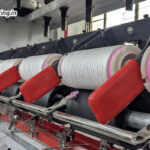
The global textile industry is undergoing a massive transformation. With the advent of high-speed automated machinery and the push for “Industry 4.0” integration, the components that once seemed “secondary” are now taking center stage. Among these, the double flanged bobbin stands as a critical pillar of production efficiency. Whether it is for high-tension winding, intricate threading, or heavy-duty twisting, the bobbin is the silent workhorse of the factory floor.
However, as production speeds increase, so does the mechanical stress on these components. This is where the intersection of material science and textile engineering becomes vital. Choosing the right material for a double flanged bobbin is no longer just a matter of cost—it is a matter of durability, precision, and long-term operational viability. As a premier Flanged Bobbins manufacturer in India, Trim Engineering understands that the material is the soul of the product.
The Anatomy of Stress: What Happens During High-Speed Winding?
To understand why material choice matters, one must first look at the physics of a textile mill. Modern winding machines operate at incredible velocities. When yarn or thread is wound onto a bobbin, it exerts two types of pressure:
- Radial Compression: The layers of yarn squeeze the central tube of the bobbin.
- Axial Thrust: The yarn pushes outward against the flanges (the end discs).
If the material is too weak, the flanges will “flare” or bend outward. This leads to uneven winding, thread breakage, and potentially catastrophic machine failure. In the context of double flanged bobbins, durability is defined by the material’s ability to resist these twin forces without deforming over thousands of cycles.
1. The Rise of High-Performance Plastics (ABS & Nylon)
For many years, wood or basic plastics were the standard. Today, engineering-grade polymers like ABS (Acrylonitrile Butadiene Styrene) and Glass-Filled Nylon have redefined expectations.
- Impact Resistance: High-speed environments are prone to drops and mechanical shocks. ABS provides excellent impact strength, ensuring the flanges don’t crack upon sudden contact.
- Weight Efficiency: Lightweight plastic bobbins reduce the “moment of inertia.” This means the machine requires less energy to start and stop the rotation, leading to significant power savings over a year of production.
- Smooth Surface Finish: In textile engineering, any snag can ruin a batch of high-quality silk or synthetic fiber. Plastics can be molded to a mirror-like finish, ensuring the thread glides off without friction.
2. Metal Alloys and Aluminum: The Heavy-Duty Champions
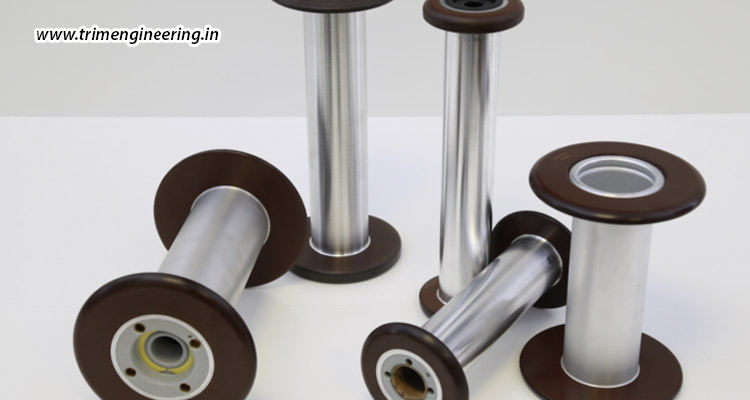
When the application involves high-tenacity industrial yarns or metallic wires, plastic may not suffice. This is where metal double flanged bobbins come into play. Aluminum alloys are particularly favored for their strength-to-weight ratio.
- Dimensional Stability: Unlike wood, which can swell with humidity, or cheap plastics that warp under heat, aluminum remains perfectly true. This precision is essential for preventing vibration at high RPMs.
- Heat Dissipation: Constant friction generates heat. Metals act as a heat sink, protecting sensitive synthetic fibers from melting or losing their tensile strength during the winding process.
As a leading Flanged Bobbins manufacturer in India, we often recommend metal alloys for twisting and steaming processes where the bobbin must endure high temperatures without losing its structural integrity.
3. The Economic Impact of Material Durability
Many procurement managers make the mistake of looking at the “unit price” rather than the “Total Cost of Ownership” (TCO). A cheaper, low-grade bobbin might save money today, but it costs more tomorrow through:
- Frequent Replacements: Low-grade materials wear out, requiring the constant purchase of new stock.
- Yarn Wastage: A deformed flange causes “trapped ends,” where the thread gets stuck, leading to wasted material.
- Machine Downtime: Every time a bobbin fails, the entire line stops.
By choosing a high-durability material, textile hubs can ensure a seamless workflow. This is why searching for a reliable Flanged Bobbins manufacturer in India is a strategic business move, not just a procurement task.
4. Customization: The Engineer’s Secret Weapon
No two textile operations are identical. The density of the yarn, the speed of the machine, and the chemical environment (dyeing, bleaching, or steaming) all dictate a different material requirement.
A specialized Flanged Bobbins manufacturer in India offers the ability to customize the flange thickness and tube reinforcement. For instance, if you are working with high-stretch Lycra, you need a bobbin with reinforced flanges to counter the extreme “crushing” force as the elastic attempts to contract.
Sustainability in Material Choice
In 2026, sustainability is a core requirement. Modern textile engineering is moving toward materials that are 100% recyclable. Both Aluminum and high-grade Polymers can be repurposed at the end of their long life cycles. Investing in durable materials isn’t just good for the machine; it reduces the industrial footprint by slowing down the waste cycle.
Conclusion: Engineering Excellence with Trim Engineering
The humble bobbin is a masterpiece of engineering. Its durability determines the quality of the final fabric, the speed of the factory, and the safety of the operators. Whether you require the lightweight agility of Nylon or the rugged endurance of Aluminum, the choice of material is the foundation of your success.
As an established Flanged Bobbins manufacturer in India, Trim Engineering is committed to providing world-class solutions tailored to the rigorous demands of the modern textile industry. Our focus on ISO-certified quality and material precision ensures that your production lines never skip a beat.